There is something oddly comforting about a clock. It keeps moving whether we are ready for the next minute or still thinking about the last one.
A message arrives, a baby girl is welcomed into the family, somebody takes a photograph, and suddenly a tiny number on the screen becomes part of a memory.
That is why a simple question such as “What time was it 14 minutes ago?” can sometimes feel more useful than it first appears.
For the example covered in this article, the current time is given as 8:45:57 AM on Friday, August 14, 2026. Subtracting a 14-minute interval gives 8:31:57 AM on the same date.
So, the answer to 14 minutes ago from now is 8:31:57 AM, assuming the starting time is 8:45:57 AM.
It sounds almost too easy, and honestly, it is. But time calculation gets surprisingly slippery when seconds, midnight, dates, different time units, or daylight changes wander into the picture.
A person can know perfectly well how to subtract fourteen from forty five and still pause when the clock says 8:05:10 and the question asks for a time fourteen minutes earlier.
And there is another little human side to it. When a daughter is born, families often remember the exact time she arrived, not merely the hour. “She was born at 8:31 in the morning” can become one of those sentences repeated for decades.
A grandmother may remember who called first. A parent may remember the clock beside the hospital bed. The timestamp is small, but the memory attached to it isn’t.
| Calculation | Result |
|---|---|
| Current Time | Now |
| 14 Minutes Ago | Current time 14 minutes |
| Time Difference | 14 minutes |
| Date | Usually the same day |
What Does “14 Minutes Ago From Now” Actually Mean?
The phrase 14 minutes ago simply means a point in time that occurred fourteen minutes before the reference point called now. The important word here is “now,” because without a starting time there cannot be one universally correct answer.
If the starting point is 8:45:57 AM, then going backward by fourteen minutes means moving the minute hand fourteen steps into the past while keeping the seconds unchanged.
So the calculation is:
8:45:57 AM 14 minutes = 8:31:57 AM
That makes 8:31:57 AM the exact time 14 minutes ago for this particular example. Nothing mysterious hiding behind the curtains, just a clean subtraction.
The same idea works with phrases such as 14 minutes earlier, 14 minutes before now, and 14 minutes prior. They are different little coats for essentially the same temporal idea. The wording changes, but the clock doesn’t care about poetry.
The Exact Answer: 14 Minutes Ago From Now
Using the supplied reference time of 8:45:57 AM, the result is straightforward.
- Current time: 8:45:57 AM
- Time interval: 14 minutes
- Calculated time: 8:31:57 AM
- Current date: Friday, August 14, 2026
- Calculated date: Friday, August 14, 2026
- Time difference: 14 minutes
- Result: 8:31:57 AM on Friday, August 14, 2026
In other words, if someone asks, “What was the time 14 minutes ago from now?”, the answer for this example is 8:31:57 AM. The date does not change because the subtraction stays comfortably within the same morning.
This is also why a good time calculator shows both the starting point and the result.
Giving only the answer can be confusing when the reader’s own clock is running at another time. A timestamp is always attached to a reference point, even when people forget that part.
How the 14 Minute Time Calculation Works

The simplest time calculation can be done without a special calculator. Start with the hour, minute, and seconds.
The starting time is:
8:45:57 AM
Subtract fourteen minutes from forty-five minutes:
45 14 = 31
The seconds remain 57, and the hour remains 8, because there is no need to cross an hour boundary.
That leaves:
8:31:57 AM
It is worth noticing that the seconds do not become zero just because fourteen whole minutes were removed. Fourteen minutes means fourteen minutes exactly, not fourteen minutes and fifty-seven seconds.
That tiny distinction is responsible for quite a few silly timestamp mistakes.
For instance, someone might incorrectly turn 8:45:57 into 8:31:00. The better result is 8:31:57 because the original seconds are preserved.
A useful mental rule is almost embarrassingly simple: when subtracting a whole number of minutes, keep the seconds exactly as they are unless your calculation crosses a special boundary and you need to borrow time.
What Time Was It 14 Minutes Ago?
People usually search this question because they need a quick answer, not a lecture about temporal mathematics. Fair enough.
If now is 8:45:57 AM, then fourteen minutes earlier was 8:31:57 AM.
That means:
- Fourteen minutes before 8:45:57 AM → 8:31:57 AM
- Fourteen minutes after 8:31:57 AM → 8:45:57 AM
Notice how the second statement reverses the first calculation. This is a useful little check when doing mental arithmetic. If your result cannot travel forward fourteen minutes and land back on the original time, something went sideways somewhere.
This reverse check trick is particularly helpful when calculating timestamps for messages, appointments, photographs, work logs, or family announcements. Nobody wants to write down the wrong time on a memory that might be kept for twenty years.
14 Minutes From Now: Looking Forward Instead
Going backward is only half of the story. The same arithmetic can travel into the future.
If the reference time is 8:45:57 AM, then 14 minutes from now is:
8:59:57 AM
Here the calculation remains on the same date, Friday, August 14, 2026.
So the two directions look like this:
- 14 minutes ago: 8:31:57 AM
- Now: 8:45:57 AM
- 14 minutes from now: 8:59:57 AM
That little three-point timeline makes the concept much easier to see. The past sits on one side, the present in the middle, and the future on the other.
Time is not really complicated until we start making it explain itself in words, which humans are very talented at doing.
The phrase what time will it be in 14 minutes therefore has the same basic solution: add fourteen minutes rather than subtracting them.
Why Exact Seconds Can Matter
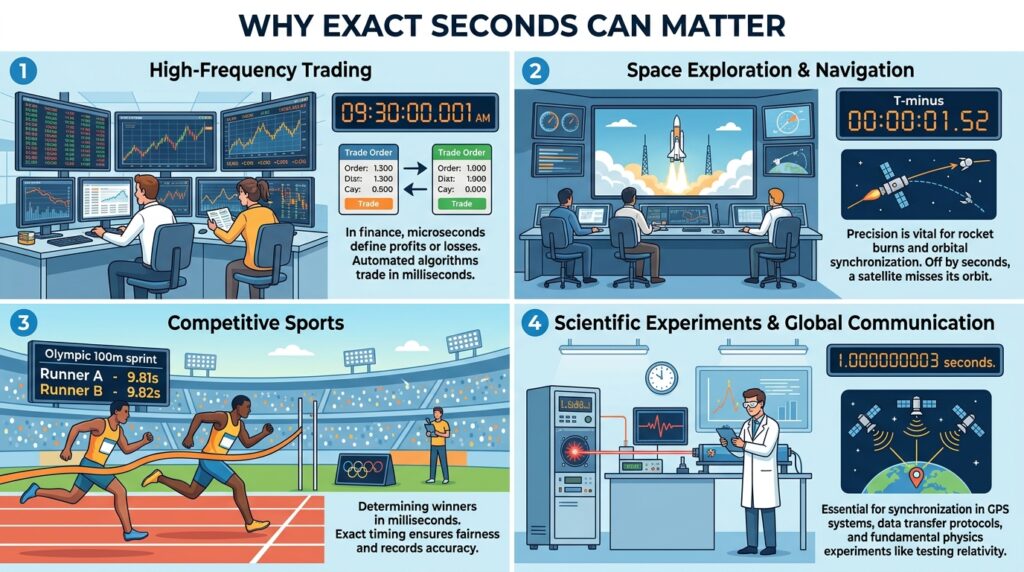
For casual conversation, saying “around 8:32 AM” is normally enough. But certain situations need an exact time.
Think about a digital photograph, an online transaction, a work-system timestamp, a security log, a sports event, or the recorded birth time of a newborn. In these situations, the seconds may matter.
A parent might say, “Our baby girl arrived at 8:31 in the morning,” while a hospital record may contain the more precise time 8:31:57 AM. Both statements describe the same moment, but they serve different purposes.
This is one reason timestamps often contain hours, minutes, and seconds even when nobody is planning to stare at all those digits. Precision sits quietly in the background until someone actually needs it.
14 Hours Ago From Now Is a Different Kind of Calculation
The phrase 14 hours ago from now looks similar to 14 minutes ago, but it behaves differently around midnight.
If the reference point were 8:45:57 AM, subtracting fourteen hours would move backward past midnight. The result would therefore fall on the previous calendar date.
That is an important lesson: a time calculation can change not only the clock reading but also the date.
Minutes, hours, days, weeks, months, and years are all time units, but they do not behave identically when calendar boundaries are involved. Fourteen minutes is usually pleasantly predictable. Fourteen months is where calendars begin quietly judging us.
14 Days Ago From Today
A date calculation is slightly different from a clock calculation because the calendar becomes the main character.
For Friday, August 14, 2026, going back 14 days ago from today gives Friday, July 31, 2026.
That is because fourteen days is exactly two weeks, and the weekday remains Friday.
This is handy for questions such as:
- What was the date 14 days ago from today?
- What date was two weeks before today?
- What was the previous date fourteen days before August 14, 2026?
The answer in this example is July 31, 2026.
It can be useful for remembering when an event happened, checking a deadline, reviewing a previous appointment, or reconstructing a sequence of family photographs. Dates are basically memory’s filing cabinets, only less tidy.
14 Weeks Ago From Today
Fourteen weeks equals ninety-eight days. Starting from Friday, August 14, 2026, moving backward fourteen weeks lands on Friday, May 8, 2026.
The weekday remains Friday because a whole number of seven-day weeks has been removed.
This is an example of why a past date calculator can be more convenient than doing everything manually. The arithmetic itself isn’t frightening, but calendar counting has a habit of producing one sneaky off-by-one error when we’re tired.
For a personal event, you might use fourteen weeks to look back at an appointment, a family gathering, a pregnancy milestone, a work project, or the date a photograph was taken.
A date that feels “about three months ago” becomes much clearer when translated into an exact calendar point.
14 Months Ago From Today

Months are trickier because they don’t all contain the same number of days.
Counting fourteen calendar months backward from August 14, 2026 gives June 14, 2025.
Here, we are not simply subtracting 14 × 30 days. That shortcut would be unreliable because months can contain 28, 29, 30, or 31 days. A proper calendar calculation respects the actual month structure.
This distinction matters whenever somebody asks for a future date or previous date based on months rather than days. “Fourteen months” is a calendar expression, not merely a pile of identical twenty-four-hour blocks.
14 Years Ago From Today
Now the calendar stretches much farther.
Fourteen years before August 14, 2026 was August 14, 2012.
The day and month remain the same because the interval is measured in calendar years. Unlike a calculation based purely on hours, a year-based calculation has to respect the calendar rather than assuming every year is exactly the same length.
That is why 14 years ago from today is best treated as a date calculation rather than simply multiplying 14 by 365 days. Leap years exist, and calendars enjoy making sure we remember them.
Why Time Calculations Become Important Around Big Family Moments
At first glance, a time calculator seems like a cold little utility. But timestamps often become emotional anchors.
When a baby girl arrives, the family might remember the exact time she entered the world.
One person is calling relatives, someone else is taking the first photograph, another person is probably trying to find a phone charger at the least convenient moment imaginable.
Years later, nobody may remember every detail of that morning. But the timestamp can pull the memory back.
A simple newborn message might say:
- “Welcome, little girl. Your arrival at 8:31:57 AM gave an ordinary Friday a place in our family history forever.”
- “Fourteen minutes can disappear in a busy morning, but the moment our daughter arrived is a minute we would gladly keep forever.”
- “May your first morning be the beginning of a life filled with bright days, kind people, and wonderfully unexpected hours.”
- “A tiny daughter arrived, and somehow the clock seemed to stop even while every second kept moving.”
- “Welcome, sweetheart. Your first timestamp is now one of our favorite numbers.”
These are not really about mathematics anymore. They use time as a doorway into affection.
Different Ways Families Remember a New Baby

Celebrations surrounding a newborn vary enormously between families and cultures. Some parents announce the arrival immediately through a short message, while others wait until grandparents and close relatives have heard the news personally.
In many families, the baby’s name, birth date, birth time, weight, and first photograph are carefully recorded.
In other homes, the practical details are secondary and everyone simply gathers around the mother and baby with food, prayers, laughter, or sleepy smiles.
A grandparent might keep a handwritten note tucked inside a drawer. Another family may create a digital album containing the first photograph and its timestamp.
Someone else will probably put the announcement on a family group chat before the coffee has finished brewing.
There isn’t one correct way to celebrate welcoming a daughter. The best tradition is usually the one that feels meaningful to the people involved.
A useful message therefore does not need to sound grand. Sometimes, “She is here, she is beautiful, and everyone is doing well” is more moving than a paragraph dressed up in fancy language. Real happiness rarely needs a costume.
How to Write a More Personal Baby Girl Message
A generic congratulations message is perfectly fine when you do not know the family closely. But if the baby belongs to your sister, brother, best friend, daughter, son, or another person you love, adding one specific detail makes the message feel alive.
Start with the relationship. Then mention the baby, the parents, or the particular moment. Finally, add a wish for the future.
For example:
- “Congratulations on welcoming your beautiful daughter. I still can’t believe the little girl we were waiting for is finally here.”
- “Your family has gained one tiny person and somehow about a million new reasons to smile.”
- “May your daughter grow surrounded by patience, laughter, good stories, and people who always make room for her dreams.”
- “Congratulations to two wonderful parents on meeting their newest little love. I hope these sleepy, messy, beautiful days stay close to your hearts.”
- “Your baby girl has arrived, and I already suspect she is going to have this entire family wrapped around her smallest finger.”
The strongest message is not necessarily the most poetic one. It is the one that sounds as if a real person actually said it.
Creative Ways to Use a Timestamp in Your Wishes

A timestamp can become a lovely detail instead of merely a technical number.
You could write the baby’s birth time into a keepsake card, place it beneath the first family photograph, include it in a digital announcement, or write it inside a baby memory book.
For a particularly sentimental message, connect the time to the feeling of the day:
- “At 8:31:57 AM, our world became a little louder, smaller, sweeter, and infinitely more beautiful.”
- “The clock recorded a time; our hearts recorded a beginning.”
- “Years from now, we may forget what we were doing at 8:31:57 AM, but we won’t forget who arrived.”
- “Fourteen minutes on a clock are ordinary. One particular minute can become unforgettable.”
- “The calendar will call it Friday, August 14, 2026. We will call it the day she came home to our hearts.”
That final distinction is important. A calendar records dates. People give those dates meaning.
Using datetime.otechworld.com for Time and Date Questions
A website such as datetime.otechworld.com can be useful for readers who prefer a dedicated online reference for time and date calculations.
A purpose built calculator is particularly handy when the calculation becomes more complicated than a simple fourteen-minute subtraction.
For basic questions, though, the underlying method is still worth understanding.
Knowing that 8:45:57 AM minus 14 minutes equals 8:31:57 AM means you can recognize whether a calculator’s output makes sense instead of treating every number on a screen as sacred.
That is the nice thing about simple mathematics: once you understand the idea, the tool becomes a convenience rather than a crutch.
Quick Reference for the Number 14
The number 14 can describe several different intervals, and each one answers a different question.
- 14 minutes ago: 8:31:57 AM, using 8:45:57 AM as the reference time.
- 14 minutes from now: 8:59:57 AM, using the same reference.
- 14 days ago from today: July 31, 2026.
- 14 days from today: August 28, 2026.
- 14 weeks ago from today: May 8, 2026.
- 14 weeks from today: November 20, 2026.
- 14 months ago from today: June 14, 2025.
- 14 months from today: October 14, 2027.
- 14 years ago from today: August 14, 2012.
- 14 years from today: August 14, 2040.
These examples show why the phrase 14 minutes ago from now should not be confused with its larger cousins. Minutes are clock arithmetic. Months and years are calendar arithmetic. They live in the same family, but they don’t exactly share a bedroom.
Common Mistakes When Calculating 14 Minutes Ago

One common mistake is subtracting fourteen from the hour rather than the minutes. If the time is 8:45 AM, fourteen minutes ago is not 8:31?
Actually, yes, it is 8:31 because the subtraction belongs to the minutes. The confusion usually appears when the minute value is smaller than fourteen.
For example, if the time were 8:05 AM, fourteen minutes earlier would be 7:51 AM. You have crossed the hour boundary, so the hour must decrease.
Another mistake is forgetting seconds. If the starting time is 8:45:57 AM, the answer isn’t 8:31:00 AM. It is 8:31:57 AM.
A third mistake is ignoring the date. Subtracting enough time to cross midnight changes the date too. At that point, a simple clock calculation becomes a combined time-and date calculation.
And finally, people sometimes use “today” as though it means the same thing everywhere. It doesn’t. Time zones matter. A timestamp can belong to Friday in one location while another location has already wandered into Saturday.
Time, annoyingly but correctly, refuses to be geographically lazy.
A Tiny Calculation Can Hold a Surprisingly Large Memory
The phrase 14 minutes ago sounds mechanical. It belongs beside calculators, timestamps, schedules, and digital clocks.
Yet fourteen minutes can also separate two completely different emotional moments.
Fourteen minutes before a baby is born, a family might be waiting nervously. Fourteen minutes later, someone might be holding a daughter for the first time. The numerical interval is unchanged, but the human experience has transformed completely.
That is perhaps why exact time questions are more interesting than they seem. We use clocks to measure duration, but we use memories to measure significance.
A clock says, “8:31:57 AM.”
A family might say, “That was when she arrived.”
Both statements can be true at exactly the same time.
Frequently Asked Questions
what time was it 14 minutes ago
14 minutes ago is the exact time you get by subtracting 14 minutes from the current time.
14 minutes from now
14 minutes from now is the time you get by adding 14 minutes to the current time.
14 minutes ago
14 minutes ago refers to a point in time exactly 14 minutes before now.
what time was 14 minutes ago
To find what time was 14 minutes ago, simply count backward 14 minutes from the current time.
what time was it 14 mins ago
14 mins ago means the time exactly 14 minutes earlier than the present time.
Read This Blog:https://moraxip.com/100-weeks-from-today/
Conclusion: The Clock Gives the Moment a Number
So, if the reference time is 8:45:57 AM on Friday, August 14, 2026, then 14 minutes ago from now was 8:31:57 AM on Friday, August 14, 2026. The calculation is simply fourteen minutes backward, with the seconds preserved.
From there, the same principle can answer questions about 14 minutes from now, 14 hours ago, 14 days ago from today, 14 weeks ago from today, 14 months ago from today, and 14 years ago from today.
The only thing that changes is the kind of calendar or time arithmetic required.
But perhaps the nicest lesson is not mathematical at all.
A timestamp is only a number until something meaningful happens beside it. A baby girl arrives. A family laughs. Someone sends a message. A photograph is taken.
A person hears wonderful news. Suddenly, an ordinary minute becomes a small landmark in a much bigger story.
So keep the exact time when it matters, but don’t forget the feeling attached to it. Years from now, the numbers may help you remember where a moment sits on the calendar. The love will remind you why you cared about that moment in the first place.
If you’ve ever had a special family moment tied to an exact time, share your favorite memory or message in the comments. Sometimes the most unforgettable stories begin with something as ordinary as a clock quietly changing by one minute.