Time has a funny little habit of disappearing when we are busy. One minute we are checking an email, finishing a work task, or waiting for a delivery, and suddenly we wonder, “Wait, what time was it 6 hours ago?”
It sounds like a tiny question, but sometimes that answer matters more than we think. A forgotten meeting, an important message, a sleep pattern, or a work record can depend on knowing the exact moment from the past.
I remember someone once saying that hours are like footprints on a beach; we can see where we have been only when we look back carefully. That thought feels oddly true, because calculating time backwards is not only about numbers.
It is about connecting the present moment with something that already happened, even if it was just a few hours earlier. And yes, sometimes our brain makes simple subtraction look harder than it really is, kinda strange but very human.
A 6 hours ago time calculator helps people quickly discover the previous timestamp by subtracting six hours from the current time.
Instead of manually counting backwards and worrying about AM/PM confusion, a tool can provide an exact time 6 hours earlier almost instantly.
This article explains how it works, why people use it, and how understanding past time calculation can make everyday planning easier.
What Time Was It 6 Hours Ago Calculator: Understanding the Basic Idea
The question “what time was it 6 hours ago?” simply means we need to move backward from the present time. If the clock currently shows 8:00 PM, then six hours earlier it was 2:00 PM.
This is called time subtraction, and it is one of the most common forms of everyday calculation.
A Time subtraction calculator works by taking the present timestamp and removing a specific number of hours.
The process sounds technical, but really it is just a digital version of asking your own mind, “Where was the clock six steps before now?” The funny thing is, many people are great at adding time forward but get confused when they need to calculate backward.
A simple 6 hours ago calculator follows a basic pattern:
- Start with the current time shown by your clock or device.
- Subtract six hours from the hour value.
- Check whether the calculation crosses midnight.
- Adjust the date if the previous day begins.
- Confirm the result using the correct timezone and format.
This process is known as past time calculation. It helps determine a previous timestamp without needing complicated mathematics. A time difference calculation is basically the bridge between now and then, connecting two points in the endless river of minutes and seconds.
What Time Was It 6 Hours Ago: How to Calculate It Manually
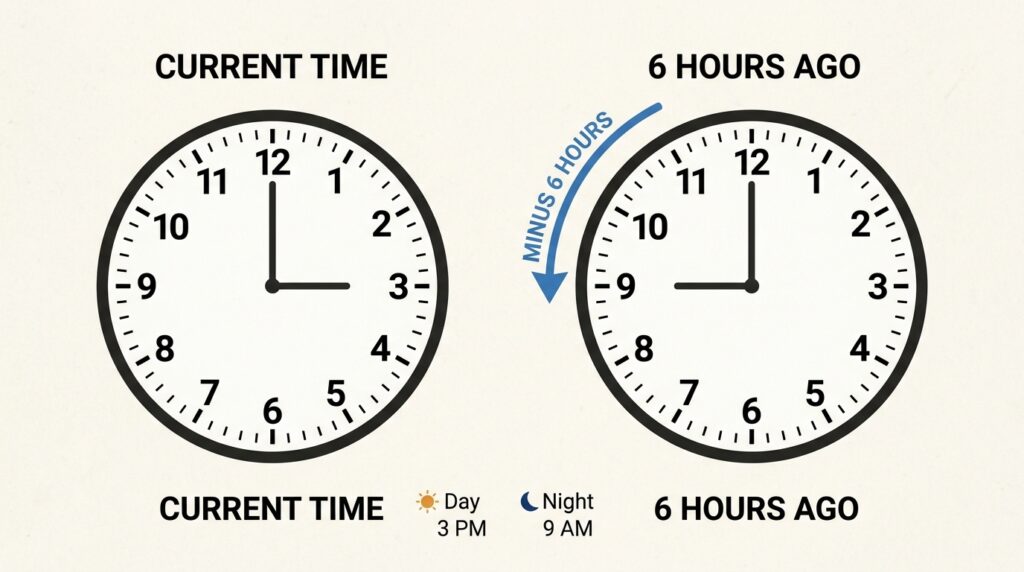
Many people search “what was the time 6 hours ago” because they want a quick answer, but knowing the manual method is still useful.
Technology is helpful, but sometimes your phone battery dies, your internet disappears, or you just want to understand the logic behind the result. Happens more often than we admit, honestly.
To calculate six hours before now, follow the simple hour subtraction method:
- Look at your local time.
- Move the clock backwards by six hours.
- Keep the minutes and seconds the same unless another adjustment is needed.
- Check whether the date changes.
For example:
If the time is 3:30 PM:
3:30 PM minus 6 hours = 9:30 AM
If the time is 2:00 AM:
2:00 AM minus 6 hours = 8:00 PM on the previous day.
That second example is where people usually make mistakes. The clock does not just become a negative number; it moves into the previous calendar day. This is called a date change or calendar day rollover.
A person asking “how do I calculate 6 hours ago?” is usually looking for a quick answer, not a complicated lesson. Still, understanding the basics helps when dealing with different situations like travel, international meetings, or old records.
How a 6 Hours Ago Time Calculator Handles Midnight and Date Changes
Midnight is where time calculations become slightly tricky. A person may think subtracting six hours is always simple, but the clock can cross from one day into another. The world keeps moving even when our calculations get confused, which is kinda amusing.
Imagine it is 1:00 AM on Tuesday. Six hours earlier was not Monday morning. It was actually 7:00 PM on Monday. The calculation moved backward across midnight.
A reliable online time calculator automatically handles:
- Midnight transition
- Previous calendar day
- AM to PM conversion
- PM to AM transition
- 24-hour format changes
- Date rollover
This is why an automatic time calculator can be useful. It reduces small human errors that happen when we calculate quickly. A person checking a timestamp from an important event probably wants confidence, not a guess.
For example, if you are reviewing a security notification, checking a work log, or verifying when a package was marked as shipped, even a one-hour mistake can create confusion. An accurate calculation keeps the timeline clean and easier to understand.
Why People Use a Time Subtraction Calculator in Daily Life
Time calculations are not only for mathematicians or computer systems. Ordinary people use them every day without even noticing. A time calculator tool becomes helpful whenever someone needs to look backward and understand what happened before.
Common uses include:
- Work shift tracking: Employees and managers may calculate previous hours to review schedules or logging records.
- Productivity monitoring: People checking focus sessions often compare the present with earlier working periods.
- Sleep schedule tracking: Someone may want to know when they went to sleep or woke up several hours before.
- Delivery tracking: Customers sometimes verify when a package update happened.
- Event verification: People may check previous timestamps for appointments, calls, or online activities.
- Activity records: Digital platforms often display times that require backward calculation.
- Scheduling reviews: Teams may compare actions taken several hours earlier.
A friend once mentioned that they use time subtraction when looking through old messages because they forget whether something happened before lunch or after. It sounds small, but these tiny moments are exactly where time tools become surprisingly useful.
What Time Was It 6 Hours Ago Calculator and Timezone Accuracy

The answer to “what time was it 6 hours ago from my current time?” depends on where you are located. Time is not the same everywhere because the planet is divided into different regions called time zones.
A good time difference calculator considers:
- Your local timezone
- The device clock
- Automatic timezone adjustment
- Current date settings
- Regional clock differences
Someone in one country might see 10:00 PM while another person elsewhere sees a completely different hour. The calculation of six hours backwards remains mathematically simple, but the starting point must be correct.
Modern tools often use system clock synchronization and automatic detection to provide a more reliable result. Your browser or device may already know your location settings, making the calculation faster.
Still, it is smart to check that your device clock is accurate because an incorrect clock creates an incorrect answer.
A real-time calculator is valuable because it provides an updated result based on the present moment instead of requiring manual entry every time. Tiny convenience, big relief.
Using Online Time Calculator Tools for Faster Results
A modern online time calculator acts like a small assistant for anyone who needs instant time information. These tools are designed for people who want to avoid counting hours manually.
A free time calculator can help users:
- Find the previous time instantly.
- Compare different timestamps.
- Convert between time formats.
- Calculate hours between events.
- Check earlier moments without confusion.
A time subtraction tool is especially useful for repeated calculations. Someone managing projects, studying, tracking habits, or reviewing records may need to perform the same type of calculation many times.
The best tools provide:
- Instant results
- Real time accuracy
- Automatic calculation
- No manual calculation
- Easy support for different formats
Technology has made time tracking much simpler. Years ago, people relied on handwritten notes and mental counting. Now an instant time finder can answer questions in seconds. Pretty neat how something so basic became part of everyday digital life.
Examples of Finding Six Hours Before a Specific Time
Examples often make time subtraction easier to understand. Here are some common situations:
- If it is 6 PM, six hours earlier was 12 PM.
- If it is 10 AM, six hours earlier was 4 AM.
- If it is 2 PM, six hours earlier was 8 AM.
- If it is 9:30 AM, six hours earlier was 3:30 AM.
- If it is 5:45 PM, six hours earlier was 11:45 AM.
These examples show that the minutes usually stay the same while the hour changes. The main thing to watch is whether the calculation enters a different part of the day.
The same logic applies when someone wants to find 1 hour ago, 2 hours ago, 3 hours ago, 4 hours ago, 5 hours ago, 7 hours ago, 8 hours ago, or 10 hours ago. The method remains the same: identify the current timestamp and subtract the required time interval.
Common Mistakes When Calculating Past Time

Even simple calculations can create confusion. People often make mistakes because they rush or forget important details. It’s funny how the smallest clock problem can suddenly feel like a puzzle.
Some common errors include:
- Forgetting the AM/PM format.
- Ignoring a midnight transition.
- Using the wrong timezone.
- Trusting an incorrect device clock.
- Forgetting the date change after midnight.
- Mixing up hours and minutes.
For accurate results, always check the starting point first. The exact time calculator result is only as correct as the original time being used.
If you are verifying past events, accuracy matters. A business reviewing work hours, a person checking travel records, or someone tracking personal routines needs a trustworthy timestamp. Small details can change the meaning of an entire timeline.
The Future of Automatic Time Calculation
Time tools continue becoming smarter. Modern systems can already provide real time time calculation, automatic timezone conversion, and synchronized clock updates.
Future time calculator tools may become even more connected with calendars, smart devices, and personal assistants.
Imagine a system that understands your schedule and instantly explains when something happened without asking you to search. Sounds a little futuristic, but honestly we are already walking that road.
The purpose remains simple: helping people understand time better. Whether someone wants to calculate backward, verify an event, or organize a schedule, accurate tools remove unnecessary stress.
Frequently Asked Questions
6 hours ago was what time
To find what time it was 6 hours ago, simply subtract 6 hours from the current local time. The result changes depending on when you check.
what was the time 6 hours ago
The time 6 hours ago is calculated by moving the clock back exactly six hours from the present time.
six hours ago
“Six hours ago” refers to the point in time that occurred exactly six hours before the current moment.
6 hours ago from now is what time
To know what time it was 6 hours ago from now, subtract 6 hours from the current time using a clock or time calculator.
what time is it 6 hours ago
The exact time 6 hours ago depends on the current time in your time zone. Simply count back six hours to get the answer.
Read This Blog: https://moraxip.com/how-long-until-2-pm-exact-countdown-timer/
Final Thoughts: Making Sense of the Hours Behind You
Finding “what time was it 6 hours ago?” is a small question with many practical uses. From checking memories to tracking work, sleep, deliveries, and events, knowing how to calculate backward in time helps people stay organized.
A 6 hours ago time calculator provides a quick solution, while understanding manual hour subtraction gives you confidence when no tool is available.
Whether you use a past time finder, an online calculator, or your own thinking, the goal is the same: discovering the correct moment that came before.
When writing down important activities, keep your timezone accurate, check your device clock, and remember that midnight can change the date. Those little habits make time tracking much more reliable.
Time is always moving forward, but sometimes the answers we need are waiting behind us. Knowing how to find the past timestamp gives us a clearer picture of our day, our work, and our memories.
So next time you wonder what happened six hours earlier, you’ll know exactly how to find it, without the confusion and with a bit more control over your timeline.